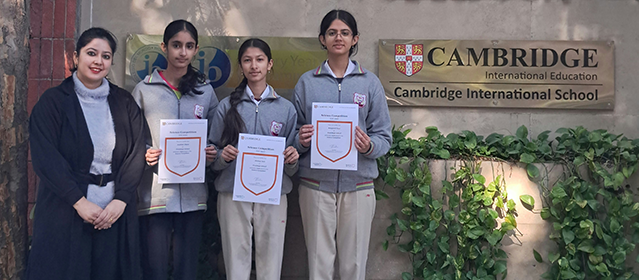
A team of three students from FirstSteps World School in India won the Sustainability Award for their investigation which tackled the global problem of unsafe drinking water.
Shreeya Sahi, Rooppreet Kaur and Anahhat Khosa identified that many rural communities lack access to expensive river-water purification systems, leaving them exposed to toxic substances and bacteria. Locally, they examined the Ghaggar River, widely used for drinking, washing and bathing, despite being severely contaminated and a health risk.
The students investigated the effectiveness of three low-cost, sustainable filtration methods—alum crystals, moringa seeds and layered sand—compared with reverse osmosis systems. They collected and analysed water samples and surveyed 100 urban households about their experiences with advanced purification technologies to assess their limitations and the need for more sustainable alternatives.
The students concluded that the final water from all the indigenous methods remained unsafe for drinking and would need to be paired with an affordable secondary purification step. They said: 'We loved getting to work in a real professional lab, testing indigenous filtration systems like Moringa, alum, and layered filters, and learning so much through hands-on research. We are deeply thankful to the judges and organizers for this opportunity and for recognizing our work; this journey has inspired us more than we can express.'
The judges said: 'The panel of judges, along with our sustainability specialist, were extremely impressed by the environmentally sensitive approach taken in developing their filtration device. It was exciting to consider how the use of indigenous plant matter could be adapted and applied by communities around the world. This project was an excellent example of delivering a sustainable solution in a sustainable way. Excellent work, team, you have perfectly captured the essence of the sustainability award, and it has been a pleasure to explore your work.'