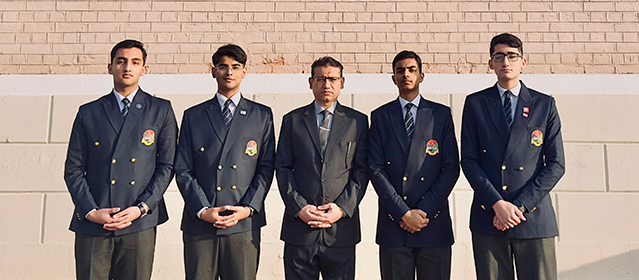
Four students from Cadet College Hasanabdal in Pakistan won the Best in Region award for their study into the ecological impact of the invasive weed Parthenium hysterophorus in Hasan Abdal, evaluating whether allelopathy could be used as a sustainable method to control its spread.
Muhammad Usman Akhtar, Syed Ayaan Kazmi, Sardar Balaaj Haroon and Wafaz Rizwan grew maize and wheat seeds in identical conditions, the only variable they altered was the concentration of aqueous Parthenium leaf leachate applied at sowing (0%, 25%, 50%, 75%, 100%). They then measured plant growth over 21 days by recording seedling height at fixed intervals. The team found that aqueous leaf extracts of Parthenium significantly suppressed the germination and growth of crops in a clear dose-dependent manner, confirming the weed’s strong allelopathic toxicity.
In a second experiment, the team showed that extracts from local plants markedly inhibit the germination and early growth of Parthenium itself, with sorghum extracts producing the strongest suppression. Overall, the findings highlight Parthenium hysterophorus as a serious threat to agriculture and biodiversity while demonstrating that locally sourced, plant-based allelopathic extracts have strong potential as ecofriendly bio-herbicides for managing invasive species.
Team member, Wafaz Rizwan said: 'Throughout this journey, we learned to actively dedicate ourselves for the betterment of our community and develop key values which we couldn’t have learned any other way. I myself learned to work in a group, as well as picking up integral principles in experimentation. Additionally, we learned about the detrimental environmental challenges around us and did our part to mitigate them.'
The judges were impressed by the team’s articulate report that ‘communicated complex scientific thought processes’.