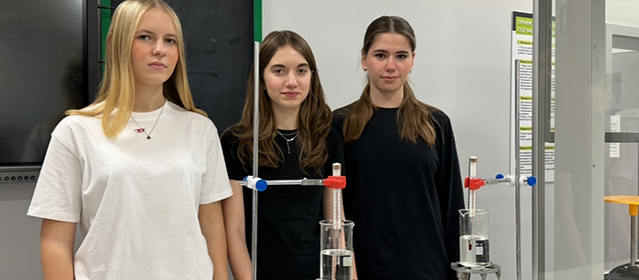
A team of three students from UA LLC Liko School in Ukraine won the Country Award for their research into producing biofuel from their school waste.
Motivated by Ukraine’s energy shortages and the need for renewable, locally available energy sources, Mariia Yeshchenko, Olha Loboda and Uliana Melnyk explored whether biofuel pellets could be produced from school-generated organic waste – specifically grass clippings and pencil shavings – as a renewable heating source.
The team mixed dried grass and pencil shavings with binding agents (potato starch or sugar syrup), compressed into pellets, and tested for thermal efficiency by measuring their ability to heat water, comparing results with commercial wood and fuel tablets. Fuel efficiency ranged from 12% to 21%, with grass pellets bound with starch showing the highest efficiency, outperforming both wood and fuel tablets.
The findings demonstrate that household waste can be successfully converted into usable biofuel, offering an environmentally friendly way to reduce organic waste and support local energy independence.
The judges said: 'This team worked collaboratively and effectively to reduce waste in their school environment, with a valuable outcome in mind. Their idea of gathering materials that would otherwise have been discarded and using them to produce a usable fuel was impressive in itself, but they went one step further by completing a comparative analysis of different versions of the fuel. This blending of innovation, problem-solving, and scientific method shows a strong commitment to research, of which the team should be very proud.'
Reflecting on the competition, team member Mariia Yeshchenko said: 'The Science Competition provides an opportunity to apply your knowledge and solve real-life problems instead of following the procedure in the practical paper. Our team decided to focus on a topic that felt both relevant and urgent to our everyday lives in Ukraine. Now power outages could last 8-16 hours a day in Kyiv. Moreover, our project provides a solution for a sustainable future.'