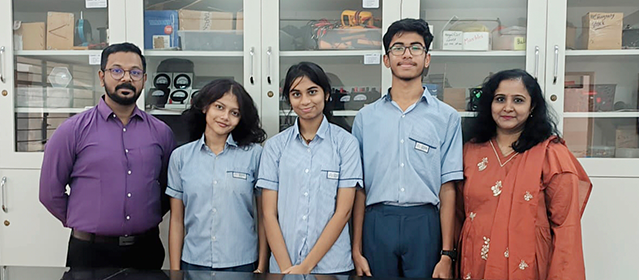
A team of three students from Deccan International School in India won the Engineering Award for their investigation into how to make their school building more energy efficient.
As temperatures continue to rise globally, our reliance on air conditioning is pushing up energy usage. Students Vidhathri Vaidya, Vineet Pulsay and R Tharikha noticed that fans were used on hot days in their school and it motivated them to think about how heat energy could be stored effectively until it is needed.
Phase-change materials (PCMs) emerged as an effective way to absorb and release large amounts of energy, and so the team decided to do a comparative study. They set out to compare the thermal performance of a wall incorporated with PCM with a conventional wall.
To conduct the experiment, the team made two models by applying plaster of Paris to carton boxes. They then incorporated paraffin wax (the PCM) into the wall of one of the models and used a room heater to increase the temperature inside the boxes. By using thermocouples to measure the heat, the team found that the wall containing the PCM heated up more slowly, and that the melting paraffin wax acted as a thermal buffer, reducing temperature changes and helping to maintain a more comfortable indoor temperature. The investigation successfully showed that PCMs can help control indoor temperature without using extra electricity.
Reflecting on the project, Vineet said: 'I enjoyed learning about how latent heat works and seeing its impact directly through our experiments and measurements. Problem solving was exciting because it allowed us to test our ideas and figure things out step by step.'
'Winning feels incredible and has boosted my confidence,' said Vidhathri. 'I enjoyed the hands-on investigation and exploring the application of science.'
The judges said: 'The team’s approach to design, creation, and analysis was logical and robust, demonstrating an impressive understanding of the importance of comparison in engineering...The judges were particularly impressed by the prototype created; rather than producing a perfect, aesthetically pleasing product, they understood the prototype’s role as a scientific model, with every feature and component offering analytical value. Great work, team – very impressive indeed!'