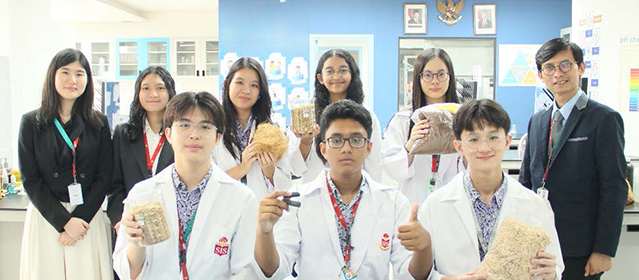
Six students from SIS North East Jakarta in Indonesia won the Best in Region award for their research into the development of eco-friendly brake pads that use organic fillers.
Ananya Rajasegar, Amabel Keona Harianto, Calista Tiffany Iwanto, Dev Milan Chakraborty, Russell Sky Cen and Jayden Tan investigated whether renewable, locally sourced agricultural waste materials (coconut fibre, rice husk, peanut shells, and sawdust) could be used as eco-friendly brake pad fillers that reduce environmental harm while maintaining performance.
The team made composite brake pads using each organic filler bonded with epoxy resin and compared them to conventional semi-metallic pads through wear resistance testing, water absorption, density measurements, and oxidation–reduction potential analysis of brake dust in water.
Results showed that organic filler pads, particularly those made with peanut shells and coconut fibre, exhibited significantly lower wear rates and mass loss than semi-metallic pads, indicating superior durability. Additionally, all organic fillers produced higher ORP values than metal-based pads, suggesting reduced toxicity. The performance and ORP data supported the team’s hypothesis that renewable filler brake pads are both more durable and less environmentally harmful, demonstrating strong potential for sustainable brake pads tailored to Indonesia’s pollution challenges.
Team member Calista Tiffany Iwanto said: 'Working with my group in the lab was a memorable experience that taught me the value of resilience and clear communication, while also allowing me to hone my research and experimental skills. More importantly, this project strengthened my curiosity in science as we explored innovative solutions that can make our environment and local community cleaner and more sustainable.'
The judges were impressed by how the team developed their thinking throughout the project and commended all students for their collaboration.