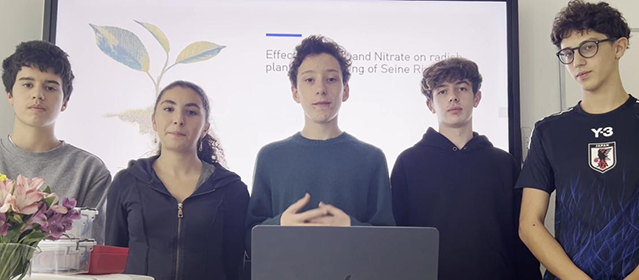
Five students from Collège Sévigné in France won the Best in Region award for their research on the impact of water pollutants on radish plants, including the toxicity of the Seine water on plants.
Nils Bravo Doussin, Elias Calafat, Alya-Rose Grimaldi, Alexandre Le and Miles Villani divided radish plants into groups and watered with solutions containing different concentrations of the heavy metal, copper (including a control with 0.0 mg/L and higher concentrations up to 1.6 mg/L) and the nutrient nitrate. Results showed that copper had a strong, concentration-dependent toxic effect, with severe plant mortality and reduced leaf surface at 1.6 mg/L, identifying this level as close to the lethal threshold for radish plants. In contrast, nitrate showed no harmful effects within the tested range, reflecting its role as a necessary nutrient at low concentrations.
The team conducted iodometric titration of Seine water and detected no measurable copper, suggesting that current levels are below those causing plant toxicity. Overall, the findings indicated that recent remediation efforts have successfully reduced copper pollution in the Seine, while highlighting the need for continued monitoring of heavy metals.
Team member Alexandre Le said: 'We chose this topic because the Seine is literally part of our city, and after all the money invested before the Olympics, everyone was wondering if the clean-up actually worked. Studying pollution on real water samples and seeing its impact on plants felt useful and concrete. It wasn’t just a random experiment, it connected to something happening around us.'
The judges praised the team for exploring an important global issue through their passion for their local surroundings.