28 Jan 2026
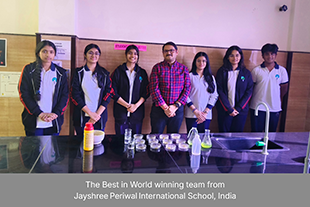
Students in India have seen off an incredibly high standard of competition from around the world to win all three global categories in this year’s Cambridge Schools Science Competition, the first time one country has achieved this.
The students won the Best in World, Sustainability and Engineering categories in the competition which is open to those aged between 14 and 16 years old studying for Cambridge IGCSEs or Cambridge O Levels. It showcases how the students turn classroom learning into real-world solutions in sustainability, engineering, and scientific research, as they work in small teams to conduct their own scientific investigation. This helps them to acquire skills that will equip them for university and the workplace beyond.
The high standard of this year’s entries impacted how they were judged, says Head Judge and Teaching Associate at the Faculty of Education, University of Cambridge, Charlie Pettit: ‘Throughout the judges’ discussions, we often adopted a "peer review" approach, evaluating each group’s research with the academic rigour typically used in a university setting.’
The winning entries were:
Best in World – chemical herbicides
Across two competition entry periods, 356 teams from around the world entered this category, with the team from Jayshree Periwal International School (Lavanya Sharma, Tanishka Goyal, Ritika Mittal, Yashkit Jain, Aarna Arora and Aishna Goyal) emerging as Best in World.
The team investigated the potential of compounds present in extracts of Helianthus annuus (wild sunflower) to chemically block the growth of another plant. This could offer an eco-friendly alternative to chemical herbicides.
Judges said the team’s work was an ‘exceptionally professional study’ and were particularly impressed by descriptions of how allelochemicals work and why they are better for the environment than the chemicals that are currently widely used.
Commenting on their win, team member Ritika Mittal said: ‘I am overwhelmed at developing the research skills that I have. This has given me confidence to use this knowledge in my future studies at university.’
Principal at Jayshree Periwal International School, Ms Madhu Miani said: ‘We are immensely proud of our students for demonstrating how curiosity, creativity, and scientific thinking can be transformed into practical solutions for real-world challenges. This competition has given them an exceptional platform to apply what they learn in the classroom to issues that truly matter, particularly in the field of sustainability. We hope their success will encourage many more young people to believe in the power of science to shape a better future.’
Sustainability Award – filtering drinking water
A team of three students – Shreeya Sahi, Rooppreet Kaur and Anahhat Khosa – from FirstSteps World School, Chandigarh won the Sustainability Award for their investigation into the effectiveness of three low cost and sustainable filtration techniques to tackle the global problem of unsafe drinking water.
The team said: ‘We are truly grateful for the chance to take part in this Science Competition. We loved getting to work in a real lab, testing indigenous filtration systems like Moringa, alum, and layered filters, and learning so much through hands-on research. Hearing from people in our community through our survey also opened our eyes to how important clean and accessible water is, and it motivated us to do our best.’
Engineering Award – energy efficiency
Vidhathri Vaidya, Vineet Pulsay and R Tharikha from Deccan International School, Bengaluru won the Engineering Award for their investigation into how to make their school building more energy efficient by using low-cost phase change materials (paraffin wax) to improve thermal regulation.
Vidhathri said: ‘Winning feels incredible and has boosted my confidence, I enjoyed the hands-on investigation and exploring the application of science.’
The competition victories come almost two years after Cambridge launched its first-of-its-kind climate literacy programme – Climate Quest – in India designed to help students develop climate awareness and become engaged in climate and sustainability issues.
Find out more about the overall winners along with the regional and country winners.
Learn more about why schools choose Cambridge IGCSE™ Sciences and explore the latest teaching and learning resources in our unrivalled school support offer. Join our webinar on 12 February, where you will also hear from Cambridge trainer and examiner Ian Connor as he discusses the questions schools ask us most often.
Register here for 08:30 – 09:30 UTC or 16:00 – 17:00 UTC.