16 Sep 2025
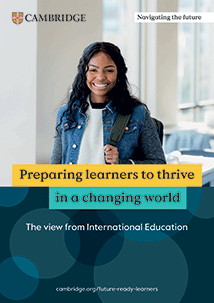
Today we are publishing a major new report which captures the voices of 3,021 teachers and 3,840 students worldwide, alongside insights from experts in education, social science, psychology, technology, government, and policy. It offers a unique view of how students across 150 countries experience education today and the skills and attributes they think are important for a future being shaped rapidly by technological advance, climate pressures, and shifting global dynamics.
Rod Smith, Group Managing Director for International Education at Cambridge, said: 'This research gives us a deeper understanding of how students and teachers are experiencing change. What strikes me most is the clarity with which it highlights a simple truth: never has the role of schools and teachers been more important. At a time of profound global change, great schools, great teachers and a clear, purposeful curriculum remain the foundations of great education.' Watch Rod discuss the report findings on our vodcast.
Research findings
Findings in the report, Navigating the future: Preparing learners to thrive in a changing world, include:
- teachers and students view self-management skills as critical for the future, but it was selected as the skill most difficult to teach (23%) and learn (19%) from a list of options.
- technology is central to this challenge: while it supports learning, students worry about distraction and over-reliance on devices, and 88% of teachers perceive attention spans to be getting shorter.
- communication skills (including social skills and empathy) are viewed as critical for success. Students value these skills for understanding the perspectives of others and feeling included. However, 61% of teachers say fear of judgement is a challenge in helping students develop their interpersonal skills, and 25% of teachers list this as the single greatest challenge.
- Psychologically safe, inclusive classrooms are essential for developing effective communication skills. Schools should purposefully create environments where students can experiment with language, consider different ways of communication, make and learn from mistakes, and grow in confidence.
- subject knowledge is essential for progression through education but seen as less important beyond it. This suggests subject knowledge is viewed as a short-term “currency” rather than a lifelong asset.
- Fewer than half of students surveyed feel prepared for their next step in education (48%) or their future beyond it (45%). But teachers are more confident: 67% feel their students are well prepared for their next step in education, and 59% say their students are well prepared for life after education.
Both students and teachers see opportunities in digital technologies to enhance learning, but voice concerns about distraction and risks to critical thinking and communication skills.
Michael Stevenson, Senior Consultant OECD High Performing Systems for Tomorrow, said: 'What inspires me about this work is that Cambridge have put students at the heart of it. The message is clear. If young people are to flourish, they need a way to develop purpose, intent and agency. That’s the role of education – and that’s why education needs to change.'
Five priorities for action
Our analysis of the report findings highlights several priorities for action to prepare students for a changing world:
- Foster greater self-management skills to help students navigate uncertainty.
- Reframe subject knowledge to increase its value in age of AI.
- Signpost skills more clearly so students recognise they're prepared for the future.
- Strengthen oracy to help students build meaningful relationships.
- Strengthen the role of school as the place to build purposeful connections.
Next steps
Cambridge has begun turning the insights from this report into action, with initiatives underway including:
- a new Skills Profile tool to help students identify and develop skills alongside subject knowledge
- teacher resources on developing executive function skills, created in partnership with Sara Baker, Professor of Developmental Psychology and Education, Faculty of Education, University of Cambridge
- a global Education Summit and the launch of a permanent student consultative forum to guide future work
- an extended Wellbeing Curriculum for students aged 14 and over.
Dr Iwan Syahril, Global Education Advisor and former Director General at Ministry of Education, Indonesia, said: 'The findings already offer powerful signals for what education must confront and design for. With deeper multi-stakeholder integration and a bold, future-oriented lens, this work has the potential to influence global practice at scale.'
Read the report
Go to Preparing learners to thrive in a changing world to read the full report.