27 Feb 2026
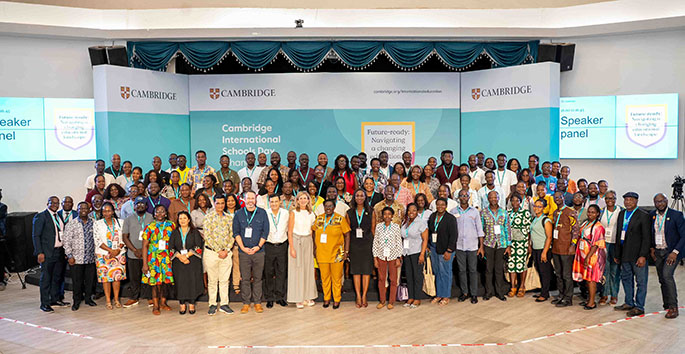
Cambridge’s recent research into future-readiness revealed that schools globally are facing similar challenges in preparing students for a changing world – and to solve them, we need to work together.
This shared responsibility inspired our first-ever Cambridge International Schools Day in Sub-Saharan Africa, held at the International Community School in Accra, Ghana on 21 February. The one-day conference focused on the theme, ‘Future ‑Ready: Navigating a Changing Educational Landscape’ and was built on insights from our Preparing Learners to Thrive in a Changing World report.
“Our ambition for the conference was to build connections, courage and shared responsibility, and to reaffirm the belief we hold deeply: that Africa’s schools, educators and learners are not simply helping students prepare for the future they will face, but for the future they want to create,” said Louise Hendey, Managing Director for Sub-Saharan Africa at Cambridge University Press & Assessment.
Her keynote address, ‘Leading through Chaos’, explored how school leaders can create coherence and calm in a world where digital overload, social fragmentation and chronic exhaustion increasingly influence learners’ well-being and engagement.
The need to position school as a safe place to build meaningful connections emerged as a priority in our research. Teachers reported challenges in helping students develop social and interpersonal skills, with 25% of teachers selecting fear of judgement as the greatest challenge, followed by social anxiety (14%) and learners’ use of digital communication (14%).
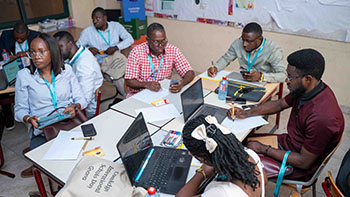 Araba Botchway, Executive Director, Admissions and Financial Aid at Ashesi University in Ghana, facilitated the breakout session, ‘Subject Knowledge: Critical for Success in Higher Education and Beyond’. Participants considered how subject knowledge must be reframed in a world of increasing AI use. Our research shows that students do not place a high value on subject knowledge when asked to consider their future beyond education, creating a challenge for educators who must ensure students develop a solid foundation of knowledge to help them think critically about AI outputs.
Araba said: “By bringing educators and experts together to exchange ideas, we can develop practical solutions that respond to these evolving educational needs. Ultimately, we collaborate to provide the confidence and capability the youth need to navigate an increasingly complex world.”
Helping school leaders navigate AI
The conference also included sessions to help schools embrace AI with confidence, led by Niall McNulty, Product Lead for AI and Edtech at Cambridge University Press & Assessment. He argued that the schools most likely to thrive with AI will not be those with the largest budgets, but those with the clearest strategic thinking. He set out some practical strategies for school leaders to help develop effective AI policies.
Other interactive sessions explored metacognition, critical thinking, communication skills, and managing conflict productively.
Thank you to everyone who joined us at the conference. We will continue to engage our community in the insights and actions outlined in our report, and take the conversation about future-ready education to other regions. Visit our ‘Preparing learners for the future’ pages for all the latest podcasts and blogs.